Luxury Watch Market Overview

The global luxury watch market is losing its department-store middle and is expanding rapidly toward ultra-premium, high-end mechanical timepieces retailing above $10,000. Many collectors now wear an Apple watch daily and one or more handmade watches for various occasions.
Data from Fact.MR indicates that the overall luxury watch market was valued at $52.4 billion in 2025 and is projected to scale from $55.6 billion in 2026 to a staggering $101 billion by 2036. Within this multi-billion dollar landscape, the $10,000+ sector represents the primary engine of value growth, driven by an insatiable consumer desire for mechanical engineering and brand heritage.
The Creators
The peak of this high-end segment remains anchored in Switzerland. Independent giants and historic horological houses—specifically Rolex, Patek Philippe, and Audemars Piguet—command the highest market gravity for five-figure timepieces. Other major luxury conglomerates, such as Richemont (via IWC Schaffhausen and Jaeger-LeCoultre) and LVMH (via Hublot), continuously fuel the trend by introducing complicated movements housed in premium or highly innovative materials.
| Brand | Owner | Estimated 2025 sales of watches over $10,000 |
|---|---|---|
| Rolex | Independent | $10.3 billion |
| Audemars Piguet | Independent | $3.1 billion |
| Patek Philippe | Independent | $3.0 billion |
| Richard Mille | Independent | $2.1 billion |
| Cartier | Richemont | $1.5 billion |
| Vacheron Constantin | Richemont | $1.1 billion |
| Franck Muller | Independent | $340 million |
| A. Lange & Söhne | Richemont | $290 million |
| Jaeger-LeCoultre | Richemont | $280 million |
| Jacob & Co. | Independent | $220 million |
Morgan Stanley and LuxeConsult estimate each brand's total revenue in Swiss francs, shown here in dollars at 2025's average rate. Nobody publishes how much of that revenue comes from watches priced over $10,000, so these figures are estimates. Audemars Piguet, Patek Philippe, Richard Mille, Vacheron Constantin, A. Lange & Söhne, and Jacob & Co. sell almost nothing below $10,000, so all their revenue counts. Rolex, Cartier, Jaeger-LeCoultre, and Franck Muller sell many watches below that price. For those four, I subtracted the less expensive models, using each brand's price list and its average price per watch. That leaves about 78% of Rolex's revenue, 35% of Cartier's, 45% of Jaeger-LeCoultre's, and 85% of Franck Muller's.
The consumers of luxury timepieces
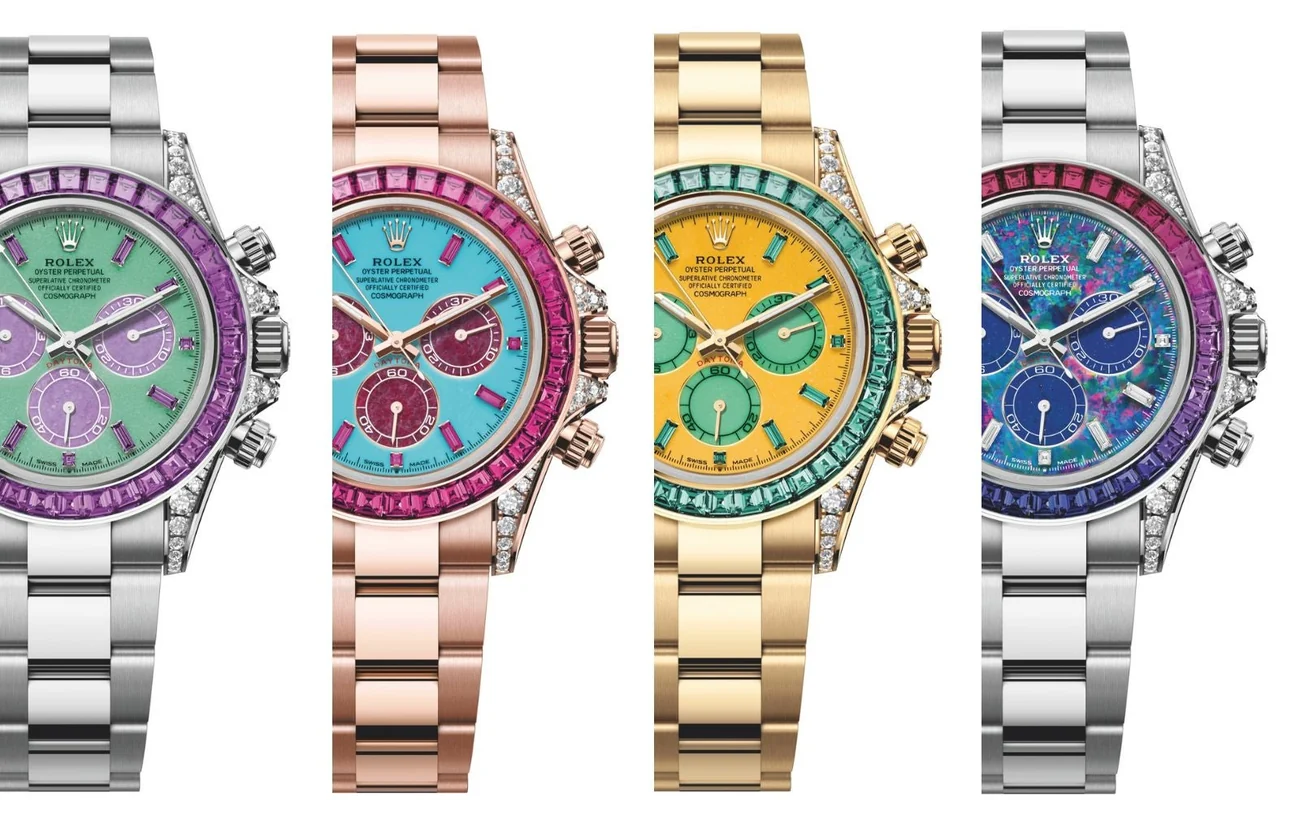
In September 2026, a set of four gem-set Rolex Daytonas fetched £37.3 million at a charity auction:
Geographically, these elite timepieces have primarily gone to the United States, which acts as the single largest national market backed by a massive, wealthy collector base. Over the last few years, a significant volume has also streamed into Western Europe—particularly Germany and the UK—as well as affluent pockets of East Asia and the Middle East, where high-end mechanical watches are treated as wearable alternative assets.
Above $10,000, most watches sell for less than $50,000, but the money gathers at the top. Watches over $50,000 are about one in nine sold and about 40% of what buyers spend.
| Retail price | Share of watches sold | Share of spending |
|---|---|---|
| $10,000 to $50,000 | 89% | 60% |
| $50,000 to $100,000 | 8% | 20% |
| $100,000 to $500,000 | 3% | 15% |
| Over $500,000 | Under 1% | 5% |
These shares are estimates for 2025 and count only watches priced over $10,000. Nobody publishes sales in these price bands, so I built them from the price lists and average prices of the brands in the table above, which make up about three-quarters of this market, plus a rough allowance for every other brand. Morgan Stanley published one related figure: watches priced over CHF 50,000, about $60,000, made up 1.4% of all Swiss watches and 37% of their export value in 2025.
A 5-Year Retrospective and Future Horizon
Looking back over the past five years (2021–2026), the market trend has been a story of extreme polarization. The pandemic-era boom triggered unprecedented secondary market hype, which eventually stabilized into a more mature, value-driven cycle by 2026. Rather than chasing speculative volume, buyers have pivoted sharply toward direct "clienteling," authorized retail verification, and technical mastery, such as Rolex's highly publicized 2025 Land-Dweller release.
Heading into the next decade, the market is projected to grow at a steady 6.1% CAGR. The future focus will squarely be on long-term servicing capabilities, movement transparency, and the widening appeal of high-end mechanical watches among younger demographics.
The Chinese Horological Renaissance
While Switzerland dominates the macro-numbers, a fascinating micro-trend has emerged in the East. Two independent Chinese watchmaking firms—Qin Gan and Atelier Wen—have broken traditional molds by crafting exceptionally high-quality, handmade watches that rival European finishings. Utilizing ultra-complex, hand-guilloché dials and specialized in-house calibers, these boutique independent makers have recently secured prestigious international recognition and design awards, proving that China is rapidly establishing its own footprint in legitimate, elite haute horlogerie.
The Rise of "Superclones"
Parallel to the legitimate market, China’s industrial manufacturing sector has birthed an underground phenomenon: high-quality "Superclones." Produced by underground factories (such as Clean Factory or VS Factory), these counterfeits are no longer the cheap, easily identifiable fakes of the past.
- The Build: Utilizing genuine 904L stainless steel and jewel pivots, and clone movements that visually mimic Swiss calibers down to the bridges and balance wheels.
- The Impact: These fakes have become so sophisticated that even seasoned dealers often require a loupe, timegrapher, or full case-back removal to verify authenticity.
- Market Friction: According to Fact.MR, counterfeit and unauthorized sales remain a top three drag on the legitimate market, eroding a portion of the absolute growth opportunity and forcing authorized retailers to offer highly digitized, foolproof proof-of-authenticity metrics to protect buyers.